Introduction
The journey of drug development, from initial discovery to regulatory approval, is a long and complex process, typically spanning 10 to 12 years. However, this duration can fluctuate, largely depending on how similar the novel drug is to existing commercialised drugs, and the specific regulatory endorsement process it requires.
Only 8 to 10% of drugs that enter preclinical trials ultimately receive approval by the relevant Regulatory Authority – a statistic that highlights the rigorous standards that must be met to ensure patient safety and efficacy. Securing approval is no easy feat!
Step 1: Discovery and Development
Drug development begins with the Discovery stage, where scientists screen thousands of potential compounds to identify those with therapeutic potential. Only a select few progress to the Development stage, where researchers conduct extensive studies to determine key characteristics such as:
- How the drug is absorbed, distributed, metabolised, and excreted
- Optimal dosage levels
- Potential adverse effects
- Effectiveness compared to existing treatments
This foundational research sets the stage for further testing and regulatory review.
Step 2: Preclinical Research
Before testing in humans, a drug must undergo preclinical research, which consists of In-Vitro and In-Vivo studies.
These studies assess the drug’s proper dosage, toxicity levels, and overall safety profile. Adherence to Good Laboratory Practice (GLP) is essential to ensure reliable and ethical research outcomes. If results are promising, the drug can move to human clinical trials.
Step 3: Clinical Research Phase Studies
Clinical trials are conducted in phases to evaluate the drug’s safety and effectiveness:
- Phase 1 – This initial phase involves a limited number of individuals and focuses on defining the safety profile of the investigational medicinal product (IMP), understanding its absorption by the body, establishing the correct dosage, and identifying any potential adverse events.
- Phase 2 – A larger group is administered the IMP to monitor safety, assess effectiveness against specific diseases, and determine the most effective dosage.
- Phase 3 – Conducted on a broad population, this phase confirms the IMP’s effectiveness, identifies rare side effects, and gathers data for regulatory submission. The effectiveness of the IMP for specific diseases is also examined.
- Phase 4 – This phase, if required, analyses the long-term risks, benefits, and Adverse Events (AEs) when the IMP is consistently used across a wider population.
All clinical trials must follow strict guidelines, such as ICH GCP E6 R2 and ICH E8 R1, to ensure compliance and data integrity.
Step 4: New Drug (IMP) Application Submission, Review, and Licensing
Once clinical trials demonstrate a drug’s safety and efficacy, a New Drug Application (NDA) or Investigational Medicinal Product (IMP) application is submitted to regulatory authorities. This submission includes:
- Clinical trial data
- Proposed labeling
- Safety updates
- Drug abuse information
- Patent information
- Data from international studies
- Institutional review board (IRB) ethics compliance information
- Directions for use
Regulatory agencies then conduct a thorough review, inspect clinical trial sites, and work with the applicant to finalise prescribing information before granting approval.
Step 5: Post-Marketing Surveillance (Pharmacovigilance)
Even after approval, drug safety monitoring continues through pharmacovigilance programs. Regulatory bodies oversee real-world usage, tracking adverse events and taking action if new safety concerns arise. Compliance with regulations, such as EMA Good Pharmacovigilance Practices (GVP) and FDA safety guidelines, ensures continued patient protection.
Summary
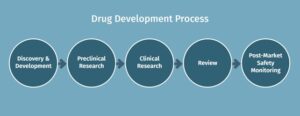
Bringing a drug from discovery to approval is a rigorous, multi-step process designed to ensure patient safety and treatment efficacy. Each stage—discovery, preclinical research, clinical trials, regulatory review, and post-market surveillance—plays a crucial role in delivering safe and effective medicines to those in need. While the process is challenging, it remains essential in advancing medical science and improving global healthcare.
Interested in learning more? Contact us today to find out how we can help with your technical needs.
Similar posts